
TyreSafe is calling on the UK’s equine and equestrian community to take immediate action on tyre safety, as new national data highlights a rising number of preventable tyre-related breakdowns involving trailers and horseboxes.
The warning follows a comprehensive four-year analysis of Strategic Road Network (SRN) data (2022–2025), which reveals a widening maintenance gap across the towing sector—one that poses a direct risk not only to road users, but to the welfare of horses in transit.
A preventable risk to horse welfare
The latest figures show that towing-related breakdowns have reached 4,830 incidents annually, with tyre issues responsible for between 25% and 28% of all cases.
This means that one in four towing breakdowns is caused by tyre failure, a largely avoidable issue that can lead to dangerous roadside stops, prolonged journey times, and increased stress or injury risk for transported horses.
Stuart Lovatt, Chair of TyreSafe, said, “When transporting horses, a tyre failure is not just an inconvenience—it’s a serious animal welfare issue. Horses are particularly vulnerable during breakdown situations, especially on high-speed roads. The fact that one in four incidents is tyre-related shows how much of this risk is preventable.”
Horseboxes and Trailers: A Growing Concern
While some areas of towing safety are improving, the data highlights increasing concern around horseboxes and trailers:
- Horsebox tyre failures have risen by 21.5% since 2022, with notable increases in key regions
- Trailers now account for nearly half (48%) of all tyre-related incidents nationally
- There are now almost as many trailer tyre failures as caravan and horsebox incidents combined
This trend reflects a broader issue: unlike regularly used vehicles, horseboxes and trailers are often left stationary for long periods, which can accelerate tyre degradation, even when tread depth appears legal.
The Hidden Danger of Tyre Age and Condition
TyreSafe is urging horse owners to be particularly vigilant about tyre age, condition, and pressure: three factors that are frequently overlooked.
Tyres naturally deteriorate over time. Exposure to sunlight, weathering, and prolonged static loads can cause cracking, hardening, and structural weakening. This is especially relevant for equine transport, where vehicles may be used infrequently but carry heavy, live loads when they are.
UK law also places strict requirements on certain vehicles: tyres over 10 years old are banned on the front steering axles of goods vehicles over 3.5 tonnes, including many horseboxes.
A Simple Message: ACT Before Every Journey
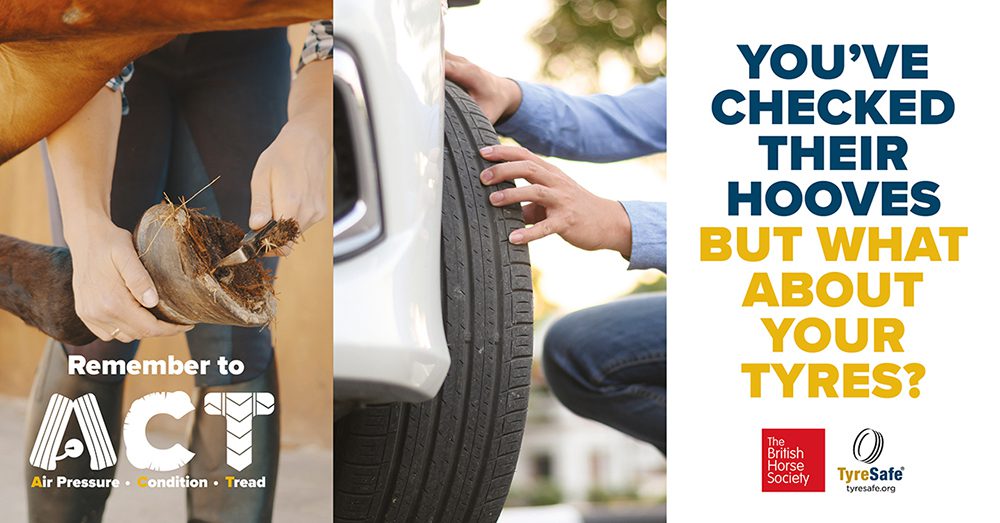
TyreSafe is encouraging all horse owners, riders, and transporters to adopt a simple pre-journey check using the A.C.T. method:
- A – Air Pressure: Check tyres are inflated to the correct pressure for the load. Under-inflation is a leading cause of tyre failure.
- C – Condition: Inspect for cracks, bulges, or embedded objects. Replace tyres that show signs of ageing—even if tread is sufficient.
- T – Tread: Ensure tyres meet legal minimum tread depth (1.6mm for most light vehicles), with more tread required for safe wet grip.
Professional Standards for Equine Transport
TyreSafe is also highlighting the importance of correct tyre specification and maintenance standards:
- Always fit tyres that meet the correct load and speed rating for your horsebox or trailer
- Never mix tyre construction types (e.g. radial and cross-ply) on the same axle
- Ensure tyres across an axle are matched in size and specification
- Check tyre pressures when cold, before every journey
- Avoid overloading and ensure weight is evenly distributed
Failure to meet legal standards can result in significant penalties, including fines and penalty points—but more importantly, it increases the risk of tyre failure during transit.
Supporting Safer Journeys for Horses and Riders
TyreSafe continues to provide dedicated guidance and free resources for the equine community, helping owners understand how tyre safety directly impacts animal welfare, vehicle stability, and journey safety.
Stuart Lovatt added: “We want tyre checks to become as routine as checking tack or loading equipment. It’s a simple step that protects not just the vehicle, but the horse inside it. Safer tyres mean safer journeys—for everyone.”
Horse owners and transporters can access TyreSafe’s free equine tyre safety resources, including checklists and expert guidance, at:
www.tyresafe.org