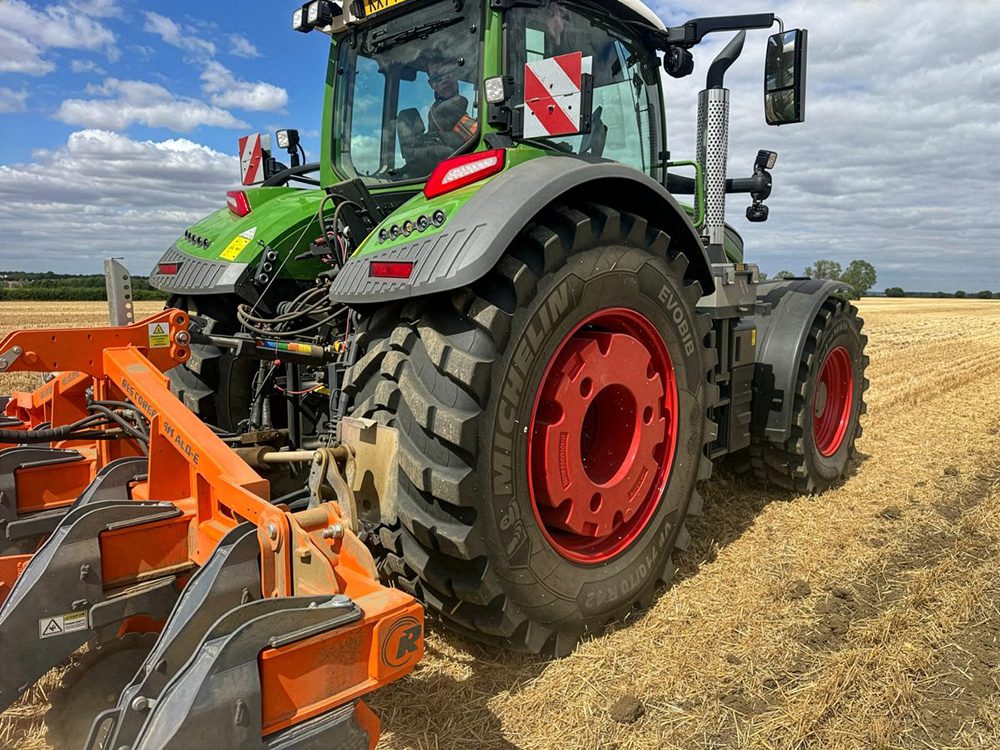
Michelin’s innovative ‘2-in-1’ EvoBib tyres are delivering impressive road and field performance for Bedfordshire-based LE Barnes & Sons, following more than a year of operation on a Fendt 728 equipped with VarioGrip central tyre inflation system (CTIS).
Operating across a diverse arable enterprise growing barley, wheat, peas and legume fallow, the agricultural contract farming business requires its machinery to perform efficiently in both field and transport applications.
Farm owner, Robert Barnes, says: “We run Michelins on everything and the EvoBibs have really impressed. When you pump the tyres up for road work, the performance is very good, which is important for us as our tractors are regularly moving from field to field. When fully inflated they just run on the central rib. As far as traction is concerned in the field, we have seen no detriment whatsoever, they are equally as good as the MICHELIN AxioBib 2s which we run on our other tractors.”
Designed specifically for tractors equipped with CTIS, Michelin EvoBib tyres feature an adaptive tread design that optimises performance according to operating conditions. At higher inflation pressures for the road, the tyre runs predominantly on its central rib to maximise fuel efficiency and wear. At lower field pressures, a larger footprint helps deliver traction while reducing soil compaction.
LE Barnes & Sons undertakes a wide range of arable operations, with the Fendt 728 which arrived direct from the dealer fitted with Michelin EvoBib VF600/70 R30 and VF 710/70 R42 tyres, working across around 450 hectares.
Having operated Michelin tyres on multiple machines for many years, the business has seen the benefits of taking tyre consideration seriously.
“Fitting the right tyres and making sure they are running on optimal pressures is so important,” says Barnes. “Previously we had two JCB Fastracs, one came on Michelin AxioBib 2s and the other came on a different manufacturer. We ran them for almost identical work, and the Michelin wear rate was considerably lower. When the Michelin tyres were around 50% worn, the others were closer to 70% worn. That’s a significant difference.”