
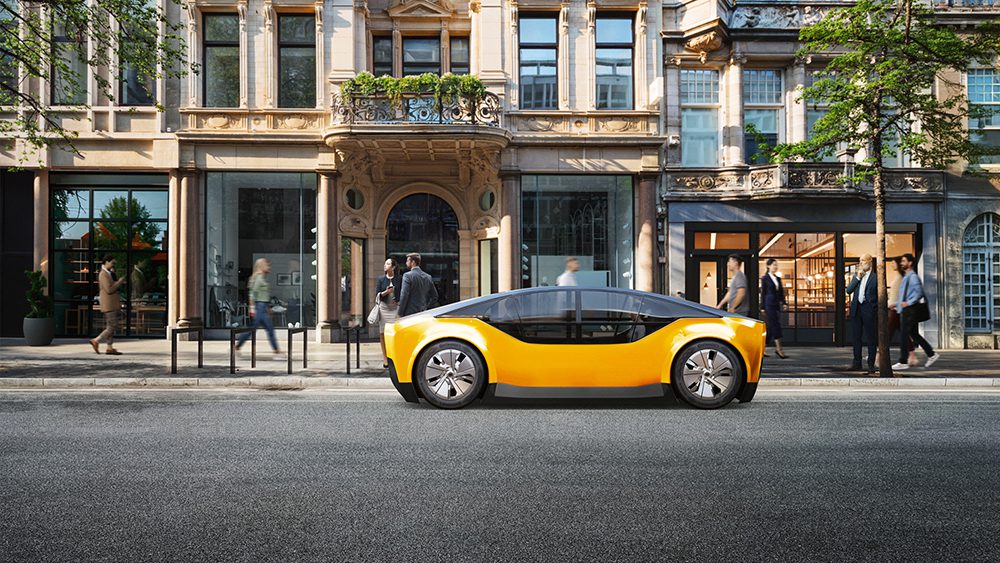
Continental will open this year’s technical conference at the Tire Technology Expo in Hanover on March 3, 2026, with a presentation on tyre technologies for autonomous driving. Dr. Andreas Topp, Head of Platform Development and Industrialisation for passenger-car tyres at Continental, will show how the future of autonomous vehicles is becoming a reality and how the tyre manufacturer is responding with innovative solutions.
“The future of self-driving vehicles has begun. We are developing tyre technologies and products that meet the unique technical requirements of these vehicles,” says Dr. Andreas Topp. “This includes topics such as interaction with smart vehicle dynamic controls, optimised fleet operations and tailored solutions for specific use profiles.”
Continental will be giving three other presentations at the conference. These will focus on carbon black recovered from end-of-life tyres and used as a filler material, tyre wear emissions beyond currently captured tyre and road wear particles and development challenges related to the Euro 7 regulation.
Identification of Recovered Carbon Black (rCB) in Vulcanised Rubber Compounds
Prof. Jorge Lacayo-Pineda, a materials evaluation expert at Continental, will speak about identifying recovered carbon black (rCB) in vulcanised rubber compounds.
Recovered carbon black is the first tyre filler material available on an industrial scale from end-of-life tyres. It is primarily obtained through the pyrolysis of end-of-life tyres and can be reintegrated into new compounds as part of a circular-economy approach. The tyre industry recognises that carbon black recovered from end-of-life tyres is not equivalent to conventional carbon black but should be regarded as a new class of filler. The differences arise from its heterogeneous composition, carbon-containing residues and thermal history. Analysing recovered carbon black in vulcanised rubber opens up new opportunities from both a technological and a regulatory perspective. But how can it be reliably identified in new rubber compounds for tyres? In his presentation, Lacayo-Pineda will discuss the challenges involved and suitable methods such as electron microscopy and molecular spectroscopy.
Tyre Wear Emissions Beyond Captured Tyre and Road Wear Particles (TRWP)
In his presentation, Dr. Frank Schmerwitz, Senior Test Engineer for tyre wear at Continental, will address tyre wear emissions beyond currently captured tyre and road wear particles (TRWP). Public discussions around tyre-related emissions primarily focus on TRWP. However, the particles collected represent only part of a tyres measured mass loss. In his presentation, Schmerwitz takes a broader view to provide a more scientifically complete understanding of underlying emission pathways. He examines additional pathways, including the release of nanoparticles, the presence of tyre wear residue on the road surface and its degradation through exposure to atmospheric oxygen and ultraviolet radiation.
Current Development Challenges in Light of New Regulations
Developing modern tyres involves balancing a variety of factors from technical performance parameters and customer expectations to regulatory requirements while maintaining the same high safety standards. When a new performance parameter becomes standardised and regulated, such as tyre abrasion under the Euro 7 regulation, it directly impacts tyre development. Binding limits for tyre abrasion and standardised measurement methods under the Euro 7 standard provide both incentives and opportunities for innovation. In his presentation, Dr. Pavel Ignatyev, a Continental expert in the physics of rubber friction and wear, will explain the parameters that influence tyre wear and how they relate to the new Euro 7 requirements. Using simplified models, he will illustrate the complexity of tyre wear and outline the remaining industry-wide challenges for further research and development. A thorough understanding of these relationships is essential to advancing technology and translating new regulatory requirements into targeted innovations.