Continental aims to minimise rolling resistance while maximising grip under all driving conditions. Rolling resistance and grip have a major impact on energy consumption and safety both for tyres and the vehicle as a whole. Growing public concern about environmental issues, rising fuel prices and the steadily increasing adoption of electric mobility mean that rolling resistance will remain a critical factor in the future of transportation. For combustion-engine vehicles, tyres account for 20 to 30% of fuel consumption. For electric vehicles, lower rolling resistance significantly reduces energy use and increases range.
“Reducing rolling resistance is one of our key development goals. The less energy a vehicle needs to move, the further it can travel saving customers money and benefiting the environment,” said Dr Christian Strübel, Continental expert for rolling resistance in passenger car tyres. “This applies to both combustion and electric vehicles. Our aim is to optimise rolling resistance, striking the ideal balance between efficiency and safety.”
But physics does not make this task easy: rolling resistance, which is the force that arises from deformation and friction as the tyre rolls, costs energy. At the same time, friction between the tread and the road provides grip, which is essential for safe braking and handling. Grip is a critical safety factor, especially since each tyres contact area is only about the size of a postcard. Reducing rolling resistance without sacrificing grip is one of the greatest challenges in tyre engineering. Continental is tackling this with advanced materials, innovative rubber compounds and optimised tread designs.
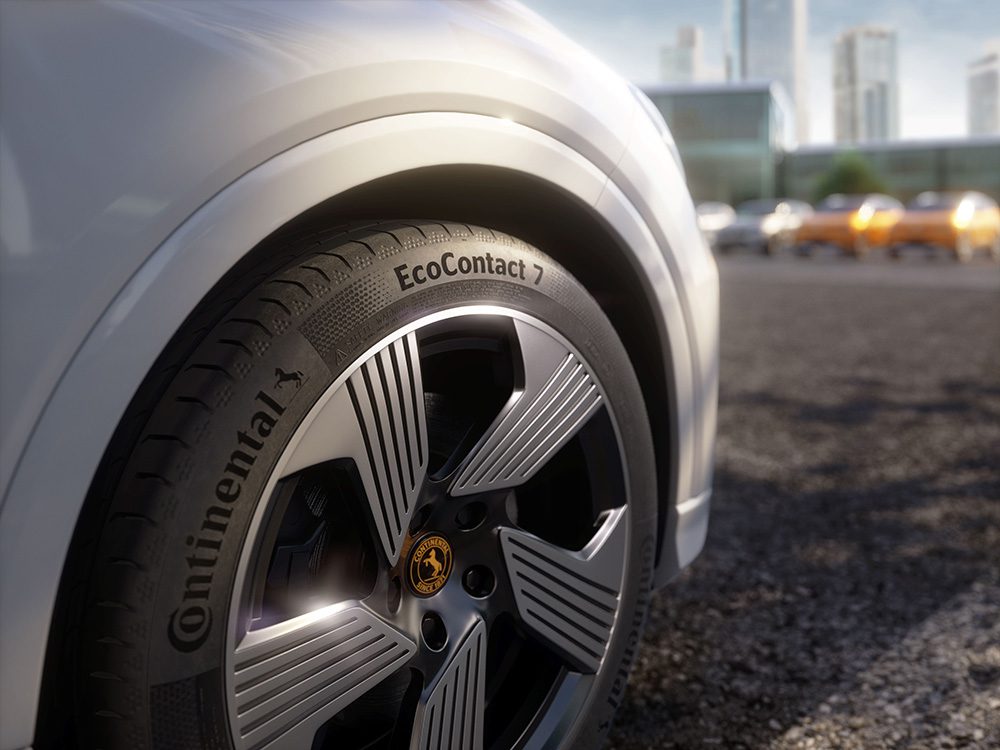
Over the past decade, Continental has been able to reduce rolling resistance in its passenger-car tyre portfolio by an average of 15%. The latest examples are the EcoContact 7 and EcoContact 7 S, introduced in spring 2025, both carrying the EU “A” label for top fuel efficiency and low rolling resistance.
Rolling Resistance is Key To Sustainable Mobility
The transport sector is one of the largest contributors to greenhouse-gas emissions worldwide. According to Eurostat, CO2 emissions from road traffic in the EU alone rose by 24% between 1990 and 2022. Globally, transportation ranks second in emissions. Reducing these emissions is vital to combating climate change. Lower rolling resistance reduces the amount of energy vehicles need, which in turn makes mobility more sustainable. Policymakers recognise this: the EU introduced a new tyre labelling system in 2009, updated in 2021, to provide transparency and promote environmentally friendly tyres. Similar regulations now exist in countries like China. The principle is simple: lower rolling resistance means lower energy consumption and a better rating. A prime example is Continental’s new VanContact A/S Eco, which has the highest EU label rating for rolling resistance, wet braking and external noise (A/A/A). Designed for evolving commercial-vehicle needs, it offers electric vehicle compatibility, resource efficiency and optimised fleet performance.
Tyres with low rolling resistance reduce energy consumption for both combustion and electric vehicles, boosting their range. This is a key criterion for automakers when selecting original equipment tyres. Today, 18 of the 20 highest-volume manufacturers of electric vehicles equip their vehicles with Continental tyres as standard.