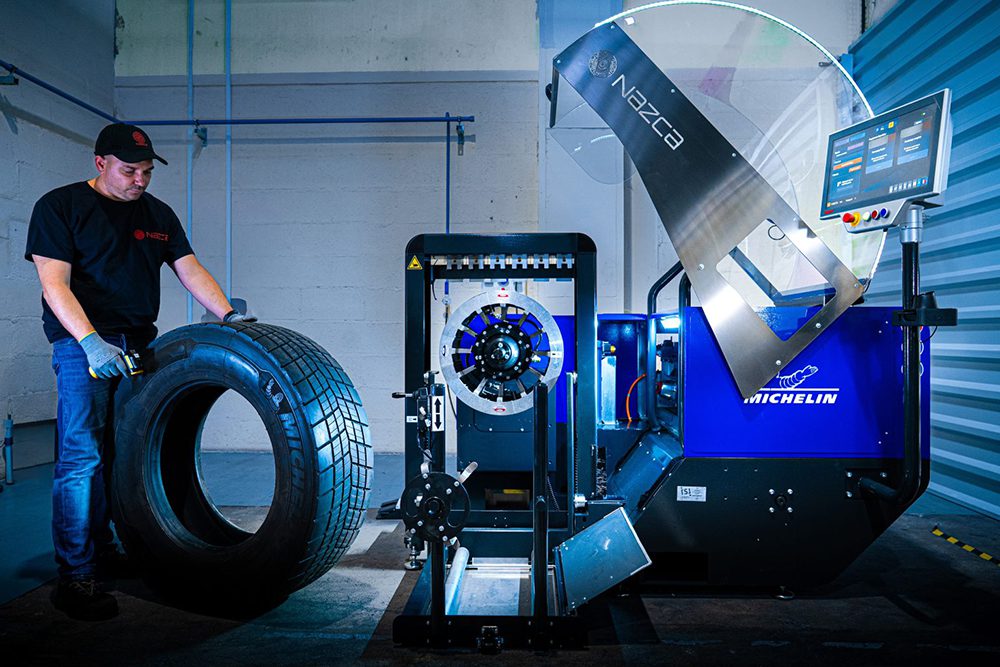
Michelin has revealed NAZCA, an automated regrooving system that modernises a key element of vehicle maintenance, at IAA Transportation 2026 in Hannover.
While regrooving is a long-established part of truck, bus, and coach tyre maintenance, the process has remained manual to this day – making it time-consuming and dependent on the skills of individual technicians.
The NAZCA innovation automates the regrooving process in line with manufacturers’ recommendations with the goal of high quality, reliability and repeatability.
The retreading machine was developed by Michelin engineers and, thanks to a high-resolution laser scanner and advanced algorithms, can measure tyres, model deformation and wear patterns, and continuously control the cutting depth. Since the geometry of each tyre is unique, the system adjusts the cutting depth across the entire width and circumference of the tyre in real time. This ensures that the tyre’s potential is fully utilised down to the very last millimetre, ensuring operators safely maximise the working life of every tyre and helping them lower the total cost of ownership.
NAZCA was tested in real-world conditions for over a year and can increase the number of regrooving operations completed by workshops. According to Michelin, it could boost regrooving capacity by 30% to 50%, depending on the workshop’s operating conditions.
Each regrooving operation requires less than three minutes of hands-on time, freeing technicians to focus on other tasks like alignment, repairs, and tyre installation or removal. This is also an advantage given the shortage of skilled workers in the industry. Automating the re-cutting process thus makes repair shops not only more profitable but also more flexible.
Designed to meet workshops’ needs, NAZCA is compatible with a wide range of tyre brands and sizes that have a robust enough casing to undergo the lifespan-extending regrooving process.
Approximately 20 NAZCA machines are currently undergoing pilot testing across Europe. In 2027, Michelin will continue rolling out this innovation in several countries. The commercial launch will be gradual and adapted to the specific characteristics of each market.